
The halo is nothing novel to Christianity. As an image it emerges across cultures and traditions.
The heroes of Homer’s Iliad, like Diomedes the son of Tydeus, are coronated with aureoles of flame —a heavenly sanction on their battle frenzy.
Moghul art is famous for its depictions of Mohammad and other Islamic saints either crowned by or totally engulfed in a mandorla of glory.
All manner of Hindu murti have halos of some kind revealing their inner sanctity and marking them as objects of proper religious devotion.
The famous kunishka casket shows a trinity of Indra, Buddha, and Brahma seated together each decked with an aura of light.
Both the Greeklings’ Apollo and the Egyptians’ Ra are depicted being crowned with the solar disc.
The list goes on. Everywhere, it seems, on God’s green earth heroes, gods, angels, divine sages, are given haloes as a sign of their being hallowed.
There just seems to be something universal about being clothed in living flame… hmmmm… it’s as if all these cultures emerged in a world created by a God who is Himself “a consuming fire” (Heb. 12:29).
Of course, I’m being snarky: all these cultures do in fact emerge in the world created by the Living God who “wraps himself in light” (Ps. 104:2-3) and who flashes forth as the Living Flame of Love (Songs 8:6). The occurrence of haloes across religious traditions is not some anthropological conundrum —its a testament to the trueness of the symbol. Its a part of the bundle of things revealed to us in the way the world is (cf. Ps. 19:1; Eccl. 3:11; Rom. 1:20).
Its not that, for instance, Indra is crowned in a halo of fire because the cult of Indra is true but rather that Indra (false god) is crowned (falsely) with a halo of fire because Indra-ites live in a world in which haloes are true; because Indra-ites live in the world created by the (true) God of haloes.
Just as whoever made the kunishka casket couldn’t help making a trinity, and just as Balaam couldn’t help prophesying what was true over Israel (cf. Num. 23-24), so also human cultures paint haloes on their icons because we all paint from a natural pallet of symbols.
But unlike pre-Christian traditions, the Bible reveals the true meaning of things. The “halo” as a symbol finally comes to “mean something” in God’s Word —it becomes more than a mysterious symbol which the various gods of the earth seem randomly to have hit upon for signification of divine sanction (one can imagine a monty-python-esque scene in which the pagan deities argue for which haphazard symbol they’ll agree to for such a purpose).
Adam and his race, made from the earth, are all called to be altars: places of communion where the abiding presence of the fiery God dwells. Altars are tables made from earth (stone, dirt, mountains, metal, etc.) on these is places fire and life. The life that is placed thereon is transformed in, caught-up into, transfigured by the Living Flame of Yahweh.
The altar-fire which is the human person (an altar perpetually running at around 98* degrees Celsius) is brought into communion with the Fire of God.
But, after the Fall, the human fire is dampened. We are waiting to be brought back into the Fire of Love. Throughout the Old Testament humans have approximate access to the shekinah flame of God, but we’re still waiting for full access.
The question from Adam to Jesus is something like this: “When can the fire of heaven —the real Fire Himself— fall on me?” Humans want the fire to fall on us. It’s what we were made for. “Judgement” (a la Sodom and Gomorrah) and “glory” (a la Elijah in Transfiguration, cf. Matt 17:1-8) are thus only two different experiences of the same event: heaven’s fire falling on the earth.
Our language and our myths are saturated with this halo/fire/altar theme. “He’s so hot right now” and “man, that party was lit” and calling good-looking folks “smokin’” and haloes drawn on Mohamad (despite the fact that, by all reliable accounts, he was not ‘hot’ in any meaningfully physiognomic way) all betray this deep truth.
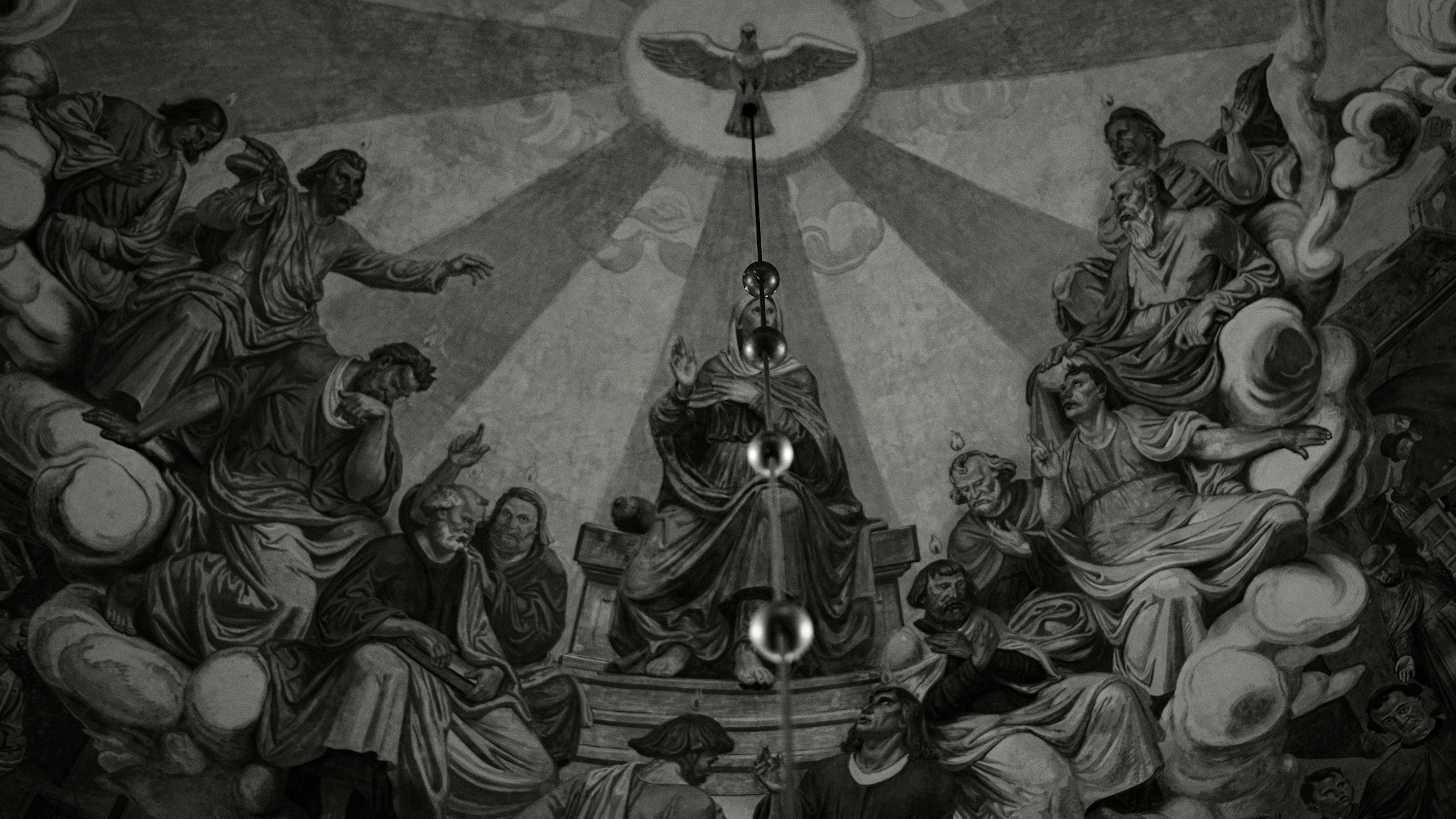
On Pentecost The Fire Falls in tongued flame.
Moreover it doesn’t fall temporarily, or merely as long as the divine warrior sanction lasts (as in the Iliad, where the heavenly fire departs as soon as the heavenly favor ends, save for Hector). On Pentecost the Fire falls and remains!
You are an altar fire, lit by the Holy Spirit when He entered your life. Pentecost, each year, is an annual renewal celebration of the lighting of that Flame. You were always made to dwell in the everlasting burnings (cf. Is. 33:14). You are a servant of the Lord who makes “flames of fires” of his servants (Ps. 104:4).
What all your pagan forebears longed for you have: a halo of divine fire proclaiming you as the heavenly scion. On Pentecost every Christian should read or have read to them the words of Psalm 16 “As for the saints in the land, they are the excellence in whom all my delight resides” (v.3).
On Sunday we will celebrate the joyous occasion of the Falling of the Fire, which is to say, the re-lighting of the altar of humanity.
Join us this weekend for a brouhaha as we celebrate the joy of the Rekindling of the Altar which Humanity was always supposed to be.
