
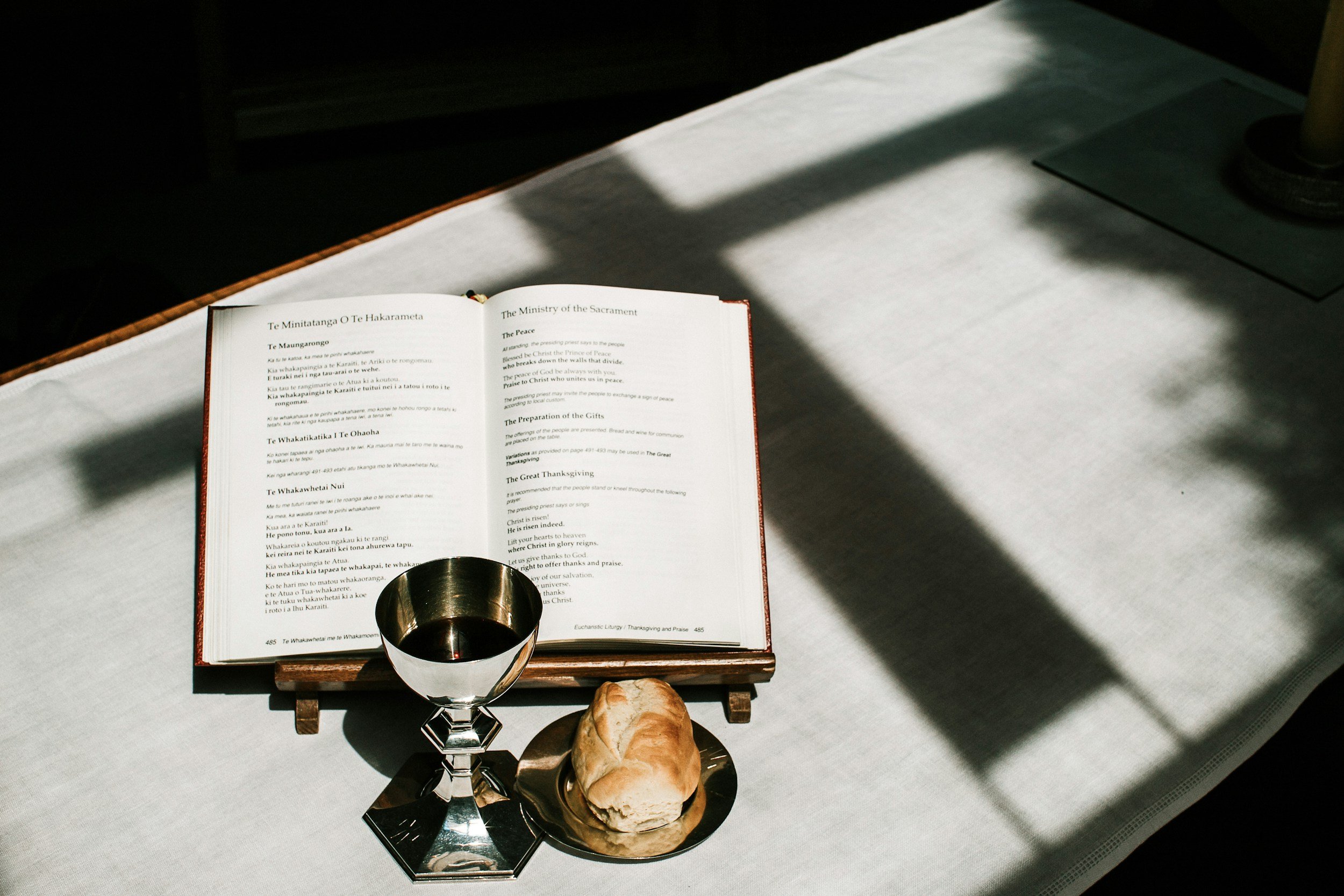
The magnificent Oliver O’Donnovan treats the question of the Presence of Christ in the Sacraments as not a matter of substances but of time.
This is where very many medieval and reformational debates got bogged-down: by making it a matter of stuff and not a question of eschatology. Let me summarize a few things:
On one side of the debates about transubstantiation / consubstantiation / memorialism, etc you have the late medieval Roman doctrine of the perpetual sacrifice of the mass. Christ’s sacrifice is cyclically repeated in the eucharistic liturgy. Substance becomes of necessary importance because we are chiefly concerned with how (i.e. under what substance) the Person of Jesus (i.e. his essence) is undergoing the repetition of his sacrifice.
On the other side of the debate is the radical protestant doctrine of intellectual remembrance. Christ’s sacrifice, once for all upon the cross, is a strictly historical moment which his faithful consider “in terms of [merely] mental recollection and memory” (O’Donnovan, p.128) even though it is an event in which the majority of the faithful through the ages have no actual experiential memory (i.e. we were not present at Golgotha in 33 AD). A kind of anemoia —nostalgia for a time in which you’ve never lived, not unlike Gen Z sense of relish in the fads of the late 1990s.
Oliver O’Donnovan notes that both of the above formulations fail to get to the root of the issue regarding Christ’s Presence in Holy Communion and Baptism “which is Christ’s eschatological presence to us” (p.128). Both of these options tend to absolutize “the gulf between our time and Christ’s, and so denies to his time that immediate authority over our time which belongs to it as the Last Time and to him as the Last Adam” (ibid).
In the two Dominical Sacraments the church is brought into participation with neither the cyclical concourse of Roman repetition nor the isolated dispensations of Protestant progressive time, but into the “Forever” of Christ’s “once and for ever sacrifice.” Eternity floods our time without distorting it or repeating itself. In the Sacraments of the Church we enter into a time that is under the Times of the Son of Man. It is, to put it plainly, on earth (with all of her times) as it is in heaven (in its fullness of time) (cf. Matt. 6:10).
Christ’s “spiritual presence”, as the articles put it, names just this truth: Jesus’ redemptive presence in the Body of his church communicated in the creatures of bread and wine. “The sacraments, then, mediate to us in our time the decisive redemption of mankind by Christ in his [time]” (O’Donnovan, 128). We become, following the Apostolic idiom, “partakers of Christ” (cf. Rom. 8:17; Heb. 3:14; 1 Pet. 4:13).
“The end has broken into history” O’Donnovan concludes, “and is proclaimed to us in the word of Christ” —that is, in the witness of the Gospel of Jesus (p.133). “And the firstfrtuits of that proclamation are the fragmentary signs of the new humanity, met in Christ’s name to live in the power of his coming, his death, his resurrection and his triumph” (ibid).
There is a church building at the Middle Street merge here in Honolulu on which is set a massive sign, visible from the multiple lemniscate concourses and intersections, “Jesus Coming Soon”. For all it lacks in artistic value, or however one may disagree with the church’s actual theology, the truth of the marquee is without question. Wherever the church is gathered by the Word of God for the ministration of the sacraments a similar banner, invisible to the eye, streams above the heads of the faithful.
