

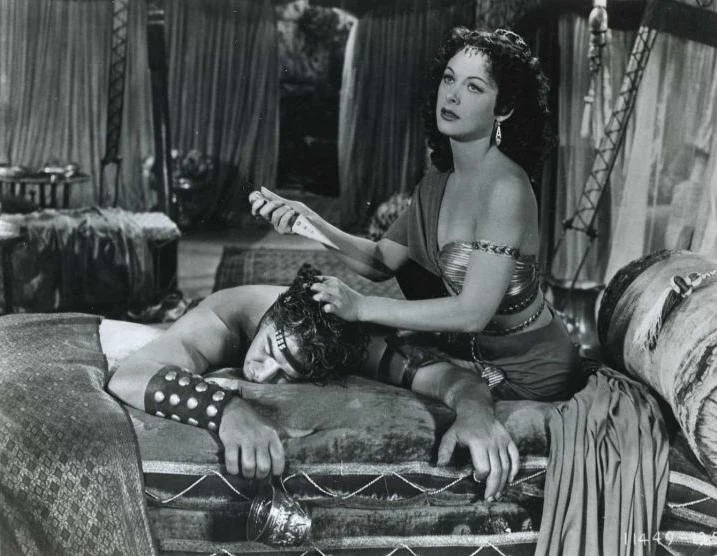
Samson is a Nazirite: he is a holy warrior, divinely called upon to a lived vow and a consecrated life before the Lord (Jdg 13:5; cf. Num. 6:1-21). He is also a Bridegroom, riddle-maker, trickster, and mighty man of valor.
His name comes from the Hebrew word for sun, shamash. Like the Sun he is a little ruler in Israel (cf. Gen 1:17). He is brights rising star of redemption in Israel.
His fall is not merely one more event in a long sequence of degeneracies. It is an apocalyptic event, the death of the Sun.
Samson does good for the long majority of his story. And yet, at last, the pain of having the wife of his youth wrongfully taken from him (cf. Jdg 14), he succumbs to allowing his light to be put under a bushel (matt. 5:15), to be snuffed-out (prov. 13:9), for the lamp of his eye to go dark (Matt 6:22-23).
Delilah’s name, you’ll be told if you look it up on most common Bible software programs, comes from a root meaning something like “to weaken” or “brought low” (i.e. from the root dalal). But there’s another etymological possibility: it’s a variation on the Hebrew word lilah meaning ‘night.’
There’s a lot of reasons I won’t go into here, but I much favor the second etymology (and I’m not alone, there’s others who have followed this line of thinking; e.g. here, here, and here; and, of course, James B. Jordan). Let us at least acknowledge, for right now, that it is a much better woman’s name (“evening lady” over “she-who-brings-low”) and move on with some reflection:
Samson, the Bright Sun, allows his glory to be eclipsed by the False Evening of Delilah. His radiant locks, like the sun’s rays, are shorn from his head and he is blinded, unable to see. He goes down in darkness and servitude.
Setting aside the conversation for now about Delilah’s culpability (i.e. was she pressured, coerced, forced, actively willing, etc.), let us just say that here we have something typological from Genesis: “and there was evening and morning…” But, unlike the creation account, here the morning of the new day, the Light is swallowed by the darkness. The sun goes out, like the harrowing prophecies of the Son of Man (cf. Matt. 24:29) and one wonders if it will rise again or if “darkness will be our only companion” (cf. Ps. 88:13). The Sun, Samson, no longer runs his course like a bridegroom (cf. Ps. 19:5), but, rather, our beloved is taken from us and we are plunged into darkest night (Songs 5:2-8; cf. Jn. 13:30; Lk. 23:44-45).
But the Lord God is good and even from Samson’s willing blindness (“I mean, c’mon man, you didn’t know she was trying to betray you after she called for the philistines the first few times? Samson, you fool…”) God brings a new day. Samson rises again, and brings the whole temple of Dagon down into the depths of the pit.
Of course, Samson perishes with them, but there is hope. Samson’s last great “rising again” points beyond himself to another future Bridegroom, the Sun of Righteousness who rises with healing in his wings (Mal. 4:2), who will not only himself rise brilliantly from the grave, but will not find himself in the grave because of his own blindness.
Rather, this True Bridegroom, the Light of Life Himself, will respond to the pain of a lost bride by giving his life for her —not breaking the covenant of his vow, but with absolute confidence in the Father to raise him back to life.
Unlike Samson, when the True Sun rises, he raises his Bride with him, into the bright splendor of the glory he had with the Father before the world began (cf. Jn 17).
