

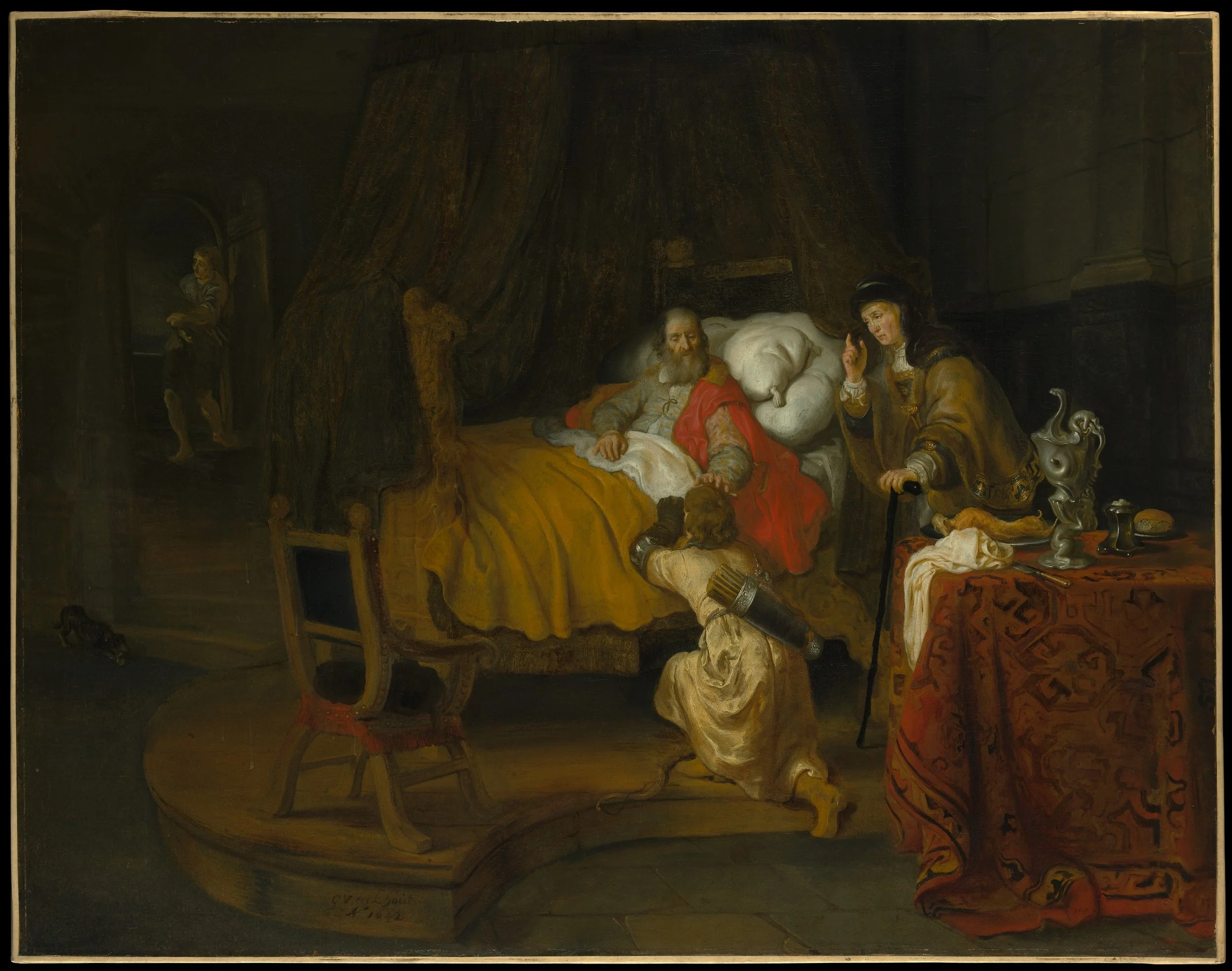
[[ Note: In what follows I am unspeakably indebted to the insights in James Jordan’s Primaeval Sants: Studies in the Patriarchs of Genesis, (Moscow ID: Canon Press, 2001), and by a sermon preached at All Saints Honolulu by Peter Leithart in October of 2022, available in our sermon archive. ]]
I was asked a few weeks ago during the Song of Solomon bible study I lead on Sunday mornings to explain what I meant in a passing comment I made about Isaac the patriarch forsaking the covenant.
My basic claim was something like this: For all of Jacob’s other short-comings, failures, sins, he is not acting sinfully or wrongfully during his early encounter with his brother Esau nor in his collusion with his mother to get his father’s (Isaac’s) blessing.
While very convenient for classic evangelical sermons about “Jacob being a thief and a scoundrel” a serpentine guy on whom God shows prevenient and irresistible grace, that just isn’t the story the Scriptures tell.
Isaac is the serpent. Rachel’s deception of her husband is akin to Jael’s deception of Sisera (cf. Judges 4:11-22, 5:24-31). And Jacob’s receiving of the covenantal blessings through cunning sets a pattern followed by later heroes such as Joseph (Gen. 44), David (1 Sam 21), Nathan (2 Sam 12), Solomon (1 Kings 3), Esther (Esther 7), Mordecai (Esther 8), where the truth is with-held from those who have tried to violate it until it can be redeployed to bring their misdeeds into the light.
The logic is the same as the one you employ when you leave your lights on while away in order to deceive robbers, or feinting in a boxing match, or pulling a play in football which imitates the line-up for another pattern but which, after tricking the opposing team into a false line-up, changes tactics mid play.
Isaac was told, through the Word of the Lord given to Rebekah (just like the Word of promise given to the Serpent in the presence of Eve, cf. Gen 3:15) that the older was appointed to serve the younger (Gen. 25:23).
Esau is hairy and rough, while Isaac is ‘pious’ or ‘blameless’ (the correct translation of the hebrew word tam; it is not “smooth” or “docile” as is often translated; it is the same word used of Job and of the blessed man of Psalm 37). Esau, like Eli the priest later, loves Esau because of the fatty meat that goes in his mouth. Jacob, the seed of promise, is loved by his mother and is a man who dwells in tents, a priestly designation like Moses or Joshua or Samuel who loved and stayed near the tent of the Lord.
Esau is a hunter, like Nimrod (Gen. 10:9) and, interestingly, like Ishamel his uncle (Gen 21:20). Isaac rewards Esau’s external strength paying no attention to the brokenness of his life: that he is a man who forsakes the covenant of YHWH to marry foreign wives, an act that breaks his mother’s heart (Gen 26:34-35), and a man who spurns his birthright for food (“his god is his belly,” cf. Phil 3:19).
Seeing all that Isaac still chooses to deny the Word of the Lord given at their birth and in something very close to a back-room bargain arranges to sell the covenantal blessing to Esau in a ritual meal. That is the deceit, that is the falsehood: a secret deal between father and son to skip-past God’s instructions.
Rebekah responds by sending Jacob in to the tent, disguised as Esau, with a meal. Jacob, whose name means something less like “grasping” and more like “wrestling” wrestles the covenant out of the hands of devourers. The story is not a tragi-comic tale of defeat and rakish ignominy; no, it is a classic Robin Hood heist story.
Application time: In today’s world it is very easy to play the Isaac —to try to “get ahead” and “get-by” and “get along with go long” making ever-widening compromises in awe of fleshly strength, or momentary satisfaction.
Don’t do this.
I think especially of the work of worship, mission, discipleship, and liturgy, it is easy today to justify all of manner of departure from biblical faithfulness with Isaac-ish logic: but look, if we concede a little with the liturgy (call it “contextualization” or “style preference”) or with the music (“who cares if the lyrics are sound theologically?”) or with the sacraments (“weekly communion won’t draw big crowds”) we hope our concession will pay dividends for external success and growth.
Be faithful, rather, with little. Love the covenant. Guard the tent of the Lord. Love his house and the habitation where he has set his Name. Be blameless, like Jacob. Do not be moved by the illusions of grandeur which the flesh so handily parades.
