

Our service was cancelled yesterday due to inclement weather and damages sustained by the facility we used.
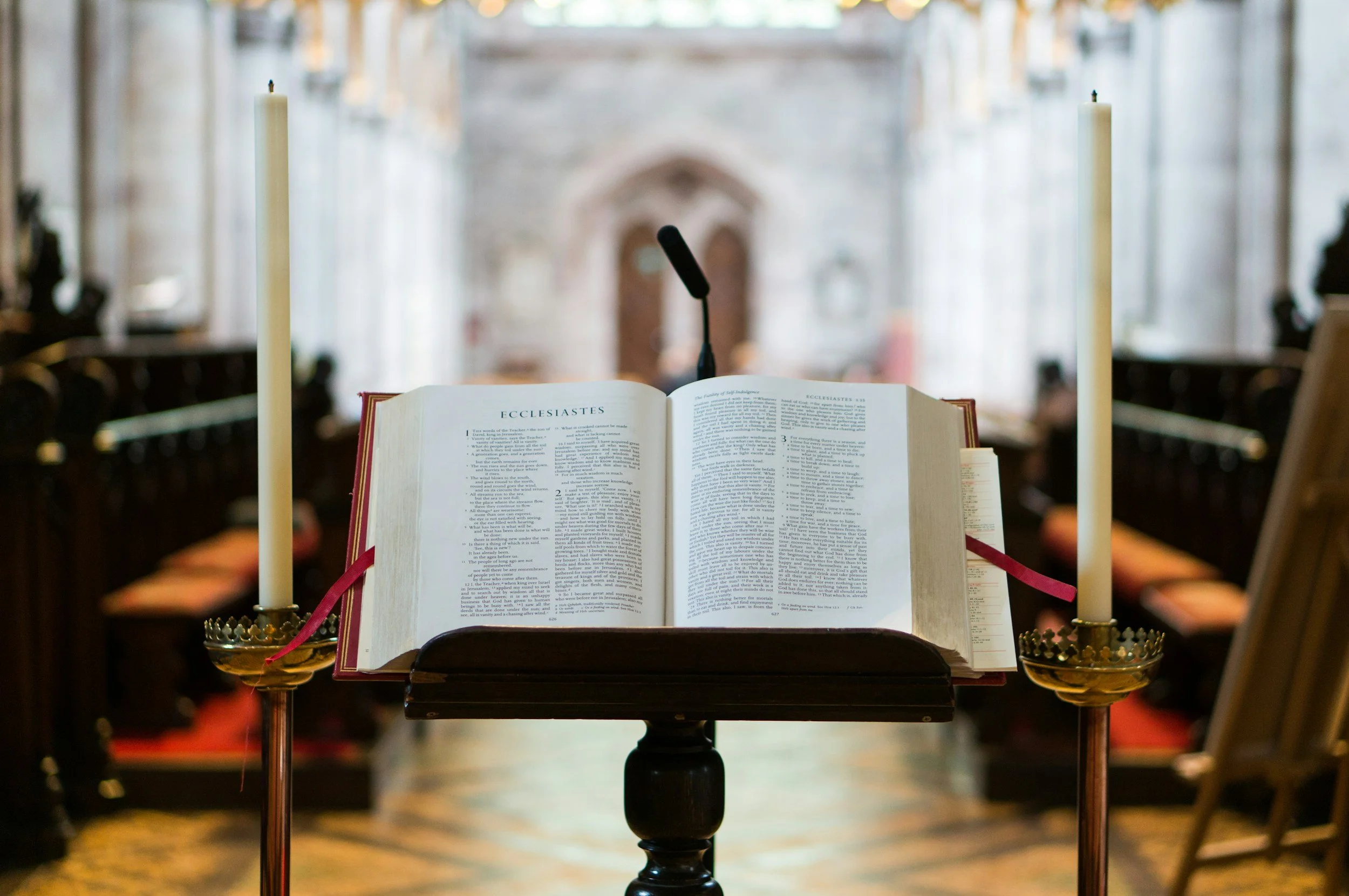
This means the notes which I had prepared for the homily lay in unpreached, wedged where I left them, folded and stuffed in the margin between the beginning of the Gospel of Luke (on the left-hand side of the page) and the account of Mary visitation to Elizabeth (on the right-hand side).
The sermon text was the Magnificat (Lk. 1:46-55) —the song which Mary sings after the pre-born Baptist leaps in the womb of Elizabeth, causing his mother to bear witness to the Reality and Mystery of the One growing in the womb of the Virgin.
May sings, “My soul magnifies the Lord….” What does this mean? To magnify?
Surely it can’t mean any of the easy things we most often mean when we employ the word: it can’t mean she made God bigger, right? It can’t mean that she was going to add something (glory, for instance) to God which he had been heretofore lacking, right? It cannot imply, in short, that God needed something or was deficient in something to which Mary Magnificat was a remedy. As the scriptures say, “Who has ever given to God, that God should repay them?” (Rom. 11:35; cf. Job 41:11; 35:7).
What Mary is declaring is that she megalynei the Lord, which is to say she extends/enlarges/exalts/multiplies Him. He fills her with His glory, the glory of Himself, and now that glory radiates though her life and multiplies the life which He fills with Himself.
A God whose glory is eternal, can eternally exalt without ever having known deficiency and without ever reaching a limit. He does this with his creatures, like Mary (and like yourself), precisely by sharing His glory with them —by drawing them into His Own Triune Life of glorification.
Give a practical example of this? Sure! St. Paul uses the same word when, later, in the midst of trials and persecutions, he declares his hope to the Philippian churches “that now as always Christ will be magnified (megalynthēsetai) in my body, whether by life or by death” (1:20).
The Lord sends His Living Word into each of our lives, we are all like little Marys —each of us a little theotokos (a ‘God-bearer’). God wants to magnify Himself in us, in our lives, in the full-spectrum of our experiences.
That sin you’ve been struggling with, maybe in secret, maybe for years? God wants to see Himself magnified in that place of struggle and shame and unrighteousness. His redemption, restoration, judgement, justice and healing makes of our sins a source of delight occasioned by grace (as Robert Jensen describes the “dark loveliness” of the Shulamite in the Song of Solomon).
That miserable commute you have each day to and from work/school/wherever? God wants to see Himself magnified in those many hours. “He is mindful of the humble estate of his servant” and He knows your frame. Let His Glory radiate in your life in the mundane and dreary.
Those moments of glory and joy? Give thanks unto the Lord for all His Goodness to you and glorify Him in your victories, blessings, and gladnesses. It is strange to say but it is often easier to pray when we hit rock bottom. It is hard to remember God when things go well. It is easy to say “My power and the strength of my hands have produced this wealth for me” (Deut 8:17). Instead, magnify the Lord, it is His glory that you are enjoying, and so sing to Him and exalt His Name. “Remember the Lord your God, for it is he who gives you the ability to produce wealth, and so confirms his covenant, which he swore to your ancestors, as it is today” (Deut 8:18).
In all that you do, dear friends, follow the example set by the Mother of God: magnify the Lord.
