

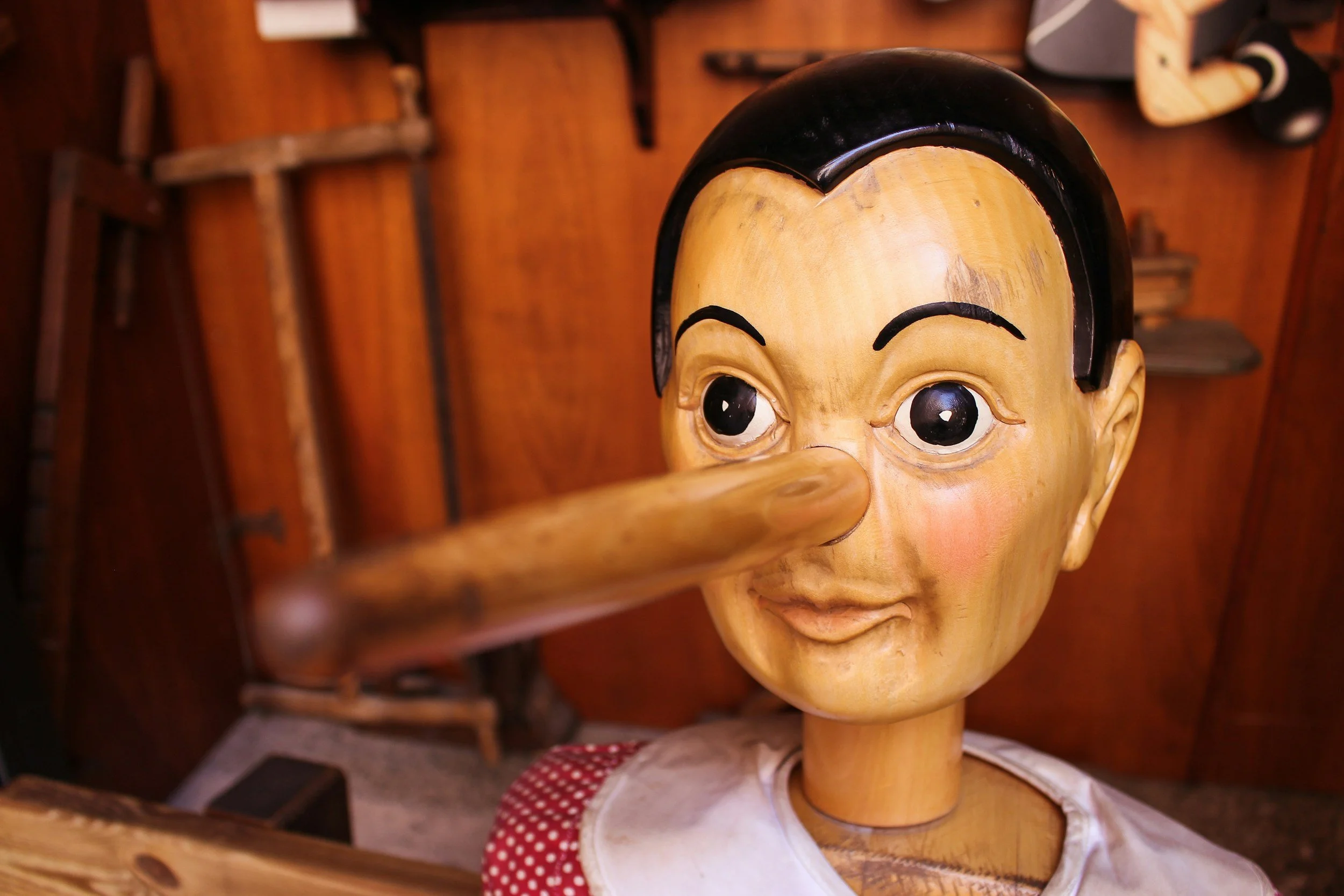
There’s a critical piece to the ending of Collodi’s original tale of Pinocchio which has been left out of every version I ever encountered. It’s not in the Golden Books version nor in the Disney cartoon version. Today I read the end of Collodi’s original (M. Murray trans., New York: E.P. Dutton, 1956) and was absolutely stunned by it. It goes like this:
“And where has the old wooden Pinocchio hidden himself?”
Asks the “new real boy” Pinocchio after coming downstairs in his new-souled flesh and having the mystery of the Fairy’s magic explained to him by Geppetto.
“There he is,” answered Geppetto, and he pointed to a big puppet leaning against a chair, with its head on one side, its arms dangling, and its legs so crossed and bent that it really was a miracle that ir remained standing.”
What!? I always thought, catechized as I was by the Disney filmic version, that the old wasted wooden puppet was swallowed-up and annihilated in the transformation. I thought, in other words, that the magic was an operation of transmutation, of alchemy —of the exchange of one substance for another (e.g. lead to gold, or wood to flesh, etc).
But no! It is the corpse of the Pinocchio which Pinocchio used to have been. It is a dead Pinocchio on which the living Pinocchio gazes.
Pinocchio turned and looked at it; and after he had looked at it for a short time he said to himself happily”
“How ridiculous I was when I was a puppet! and how glad I am that I have become a [good] little boy!”
This is not a “moral tale” as much as it is a resurrection story.
The Real Pinocchio gazes upon the deathly Pinocchio he used to be and the good news is not that God has somehow moralized the old dead wooden boy, but rather that God has killed him entire and raised him to a radically new kind of life —one that I translate in brackets above as "good” as I think it captures better Collodi’s Italian word perbene which means literally “for good” than Murray’s use of the word “nice” [a word I detest, see here].
Thinking of Jonah and Ninevah in the wake of Sunday’s lessons I am struck by this picture of forgiveness and redemption. The severity of God’s judgments are the result of his love: He is not content to merely distend the artifice of Pinocchio’s wooden life of lechery, He desires instead to end that life so that He can give birth to a New Pinocchio with a body and heart of flesh. So also He is not content in leaving Jonah sour on the hilltop or Ninevah filled with violence.
There’s a story I heard once about Augustine (though I cannot now recall where it comes from) in which the re-born Christian Augustine returns again to North Africa from his time in Italy. He is greeted in some public space by a former acquaintance who calls to him, “Yo Augustine!” But he does not reply. Angry the old friend calls again. Again the former partner in debauchery receives no reply. Angry they hasten to the baby saint, “Did you not know it was I who called you ‘Augustine?’” they ask. To this Augustine replies, “Yes, but it is no longer I who you call.”
It is good not to be a puppet any longer.
